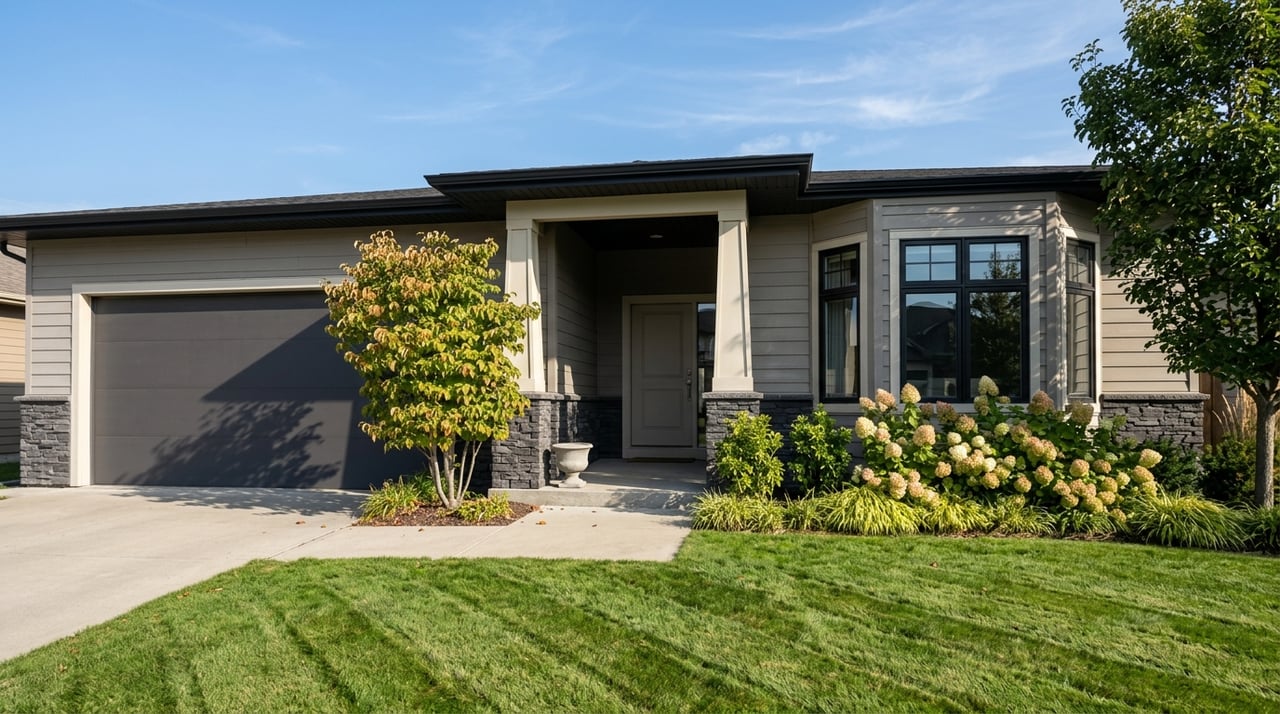
Bellevue's Median Price Fell. Somerset Still Sold in Four Days.
If you've been watching Bellevue from the outside this year, you've probably seen two headlines that don't agree with each other. One says home values are down double digits from last year. The other says the market is still tight enough that well-priced homes go under contract before the weekend is over.
Both are true. They're just describing different Bellevues.
Redfin's numbers for the three months ending May 2026 put the median Bellevue sale price at $1.5 million, down 11.3 percent from the same period a year earlier, with price per square foot down 9.57 percent over that stretch. Zillow's broader home value index, which pulls in every property type, showed a similar decline, down 11.1 percent year over year as of late June 2026. Meanwhile, a market report built on NWMLS data showed Bellevue's median climbing from $1,525,000 to $1,560,000 in the same general window, framed as a year-over-year gain.
Three reputable sources, two different directions. The disagreement isn't a data error. It's a clue.
Bellevue spent the last two years building toward one date. Sound Transit's 2 Line reached South Bellevue and Redmond Technology Station back in April 2024, then extended to Downtown Redmond in May 2025. The piece everyone was waiting on, the tunnel under Lake Washington connecting Bellevue straight into Seattle, opened on March 28, 2026, according to the City of Bellevue's own East Link project page. Six stations now sit inside city limits: East Main, Downtown Bellevue, Wilburton, the Spring District, BelRed, and South Bellevue, the last of which added a 1,500-stall parking garage.
That's five months of a fully connected line as of this writing. Long enough for the market to start showing what it actually did, rather than what everyone assumed it would do.
The assumption, echoed in a lot of national research, is that transit access adds a clean premium. A regional analysis from the American Public Transit Association found homes within a ten-minute walk of a light rail station sold for 8 to 12 percent more than comparable homes farther out. That's a real pattern, but it's a national average, and Seattle's own light rail history complicates it. Academic research on seven Rainier Valley stations found a positive price effect at exactly one of them, a negative effect at two, and no measurable effect at the rest. Downtown, dense stations like Capitol Hill and Beacon Hill showed clear premiums. Suburban ones mostly didn't.
Bellevue isn't a suburban station. It's arguably the biggest employment node the line touches outside downtown Seattle. So why did the citywide median fall right as the connection everyone wanted finally opened?
Here's the part that doesn't show up in a single headline number: the light rail didn't just change where people wanted to live. It changed what got built and sold.
Wilburton was rezoned for transit-oriented development under Bellevue Ordinance 6846, effective June 24, 2025, ahead of the Crosslake Connection opening. The Spring District, already a master-planned build-out anchored by its own station, has been adding mid-rise condo and townhouse inventory for several years. Both of those pipelines put more units on the market at price points well below the median single-family home in Bellevue, right at the moment the rail finally connected them to Seattle.
More lower-priced condo sales entering the mix pulls a blended median or average down, even if no individual home lost value. That's the arithmetic Redfin and Zillow's citywide figures are quietly reflecting. The supply data backs this up. Reporting from this spring showed Bellevue's overall months of supply climbing to somewhere between 4.3 and 5.5 months, edging toward balanced territory, with condos identified as the segment seeing the largest inventory growth, while single-family homes inside Bellevue School District boundaries stayed scarce.
Look at what's actually selling in each corner of the city and the picture gets a lot less contradictory.
| Segment | Price range reported in 2026 | What's happening on the ground |
|---|---|---|
| Single-family, BSD boundary (Somerset, Newport Hills, Eastgate) | $1.4M to $2M+ | Multiple offers, closing in days |
| Downtown Bellevue high-rise condo | $1,300 to $1,800+ per square foot | Steady demand, HOA dues $1,000 to $1,600 a month |
| Spring District mid-rise condo | $1,000 to $1,200 per square foot | New supply, priced with a stated transit premium |
| Wilburton entry-level condo | $750 to $900 per square foot | Existing stock still catching up to new construction pricing |
Somerset's single-family homes reportedly hit a median sale price near $2 million this spring, closing in four to five days. Newport Hills and Eastgate, both inside BSD boundaries, were trading in the $1.4 to $1.6 million range and moving quickly with real buyer competition. None of that reads like a market that fell 11 percent. It reads like a market where the type of home you're buying matters more than the citywide average ever did.
If you're comparing Bellevue to other Eastside neighborhoods right now, the headline median is close to useless on its own. What matters is which segment you're in.
There's a friction point worth naming directly if you're getting ready to list. Sellers who price 5 to 10 percent above recent comps aren't getting the round of negotiation they expect. They're getting ignored, then facing sharper price cuts after 30 or more days on market. That pattern showed up specifically in the condo and outer-neighborhood segments this spring, where days on market stretched to 15 to 25 days as buyers, facing more inventory than they'd seen in years, started comparing carefully and walking away from anything that felt overpriced.
That's a different risk than the one sellers faced two years ago. Back then, an aggressive list price mostly meant a slower sale. Now, with more product on the market near the stations, it can mean the listing gets skipped entirely.
Does buying near a light rail station guarantee the home will appreciate faster? Not automatically. The national data showing an 8 to 12 percent premium near stations reflects an average across many cities, and Seattle's own experience with Rainier Valley shows some stations saw no measurable lift at all. Bellevue's stations are busier and more centrally located than most of those, but that's a reason for cautious optimism, not a guarantee.
Is being inside Bellevue School District boundaries still the biggest single lever on price? Based on what's selling this year, yes. Somerset, Newport Hills, and Eastgate are all inside those boundaries and are behaving like a seller's market regardless of what the citywide median is doing. Buyers should verify exact boundary assignment for any specific address before writing an offer, since some nearby parcels fall into neighboring districts.
Should I wait for condo prices near the stations to drop further? That depends on which corridor. Wilburton's next wave of new construction isn't expected until 2027 or 2028, so current existing inventory is being priced against a future that hasn't arrived. Spring District pricing already reflects a stated transit premium tied to the March 2026 opening, which may mean less room to negotiate than the current months-of-supply numbers suggest.
Bellevue's headline price isn't wrong. It's just measuring a market that split into pieces the moment the light rail finished connecting it to the rest of the region. If you're trying to figure out what your specific budget actually buys here, in a specific neighborhood, that's less a spreadsheet question than a conversation.
That's exactly the kind of conversation The Patterson Real Estate Team has with buyers and sellers across King County every week. If you're weighing a move into or within Bellevue and want the segment-by-segment picture instead of the citywide headline, reach out and we'll walk through it together.
Ready for a no-stress, first real estate experience? Connect with the Patterson Real Estate Team and take your next move with clarity and confidence.